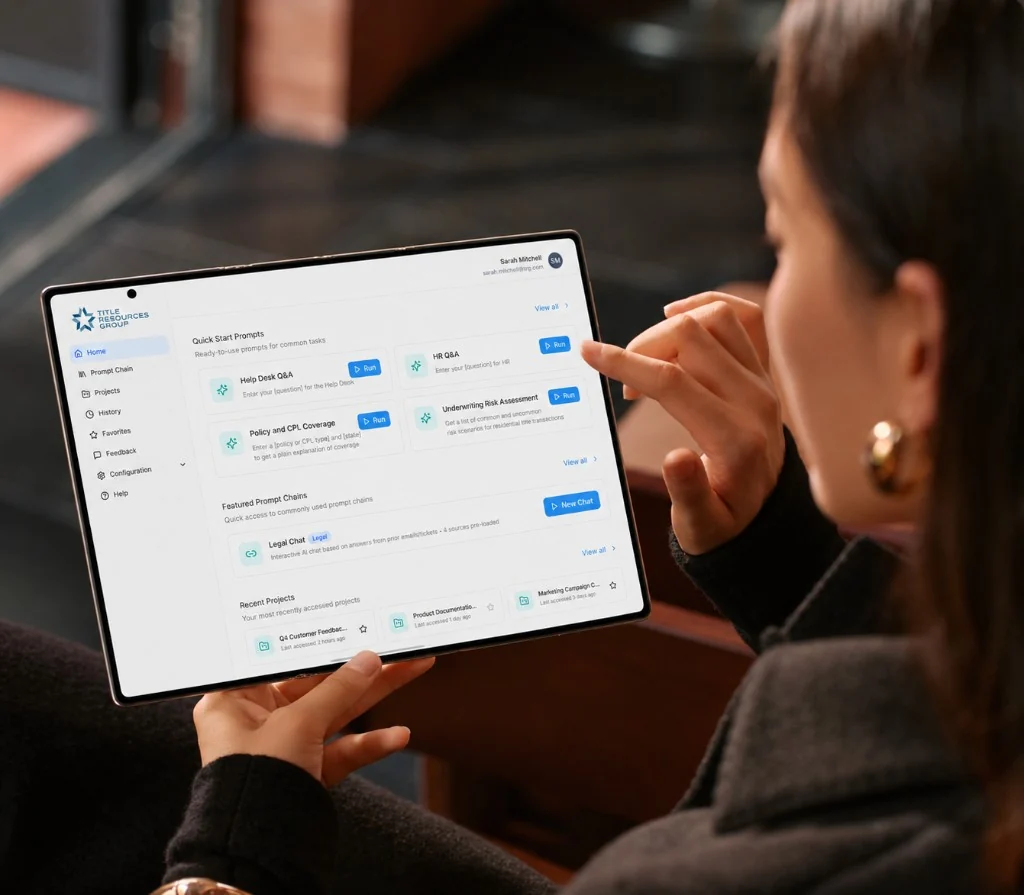
Title Resource Group's examiners checked every title search order by hand. Leadership set a target for the year: cut that cost by replacing manual effort with AI. The first production-ready product shipped in three weeks, and what is in production has already reached 30% of the target.
Title Resource Group serves title agents. When someone buys a house, a title agent verifies that the seller actually owns it and that no hidden liens, past fraud, or paperwork mistakes sit in the property's history. The company's workflow tool, TitleFlow, takes a title search order and turns it into the package the agent needs to close the deal: title report, supporting documents, invoice.
This is how the work went from fully manual to AI on every order, with an examiner approving the AI's work until the data says a step is safe to automate.
- 30%
- of the annual cost target, already in production
- 3 weeks
- to the first production-ready product
- 99 / 100
- approvals before a step is fully automated
Thousands of orders a day, all checked by hand
Before AI, every order was manual work. The operation processes thousands of orders per day in Pennsylvania alone, and one order can hold 40 or more documents.
An examiner opened a vendor package, a single PDF sometimes running over 100 pages, and split it by hand into deeds, mortgages, tax records, and probates. Then they read every document against a checklist, compared legal descriptions, plotted boundary coordinates in an external tool called a deed plotter, and picked exam codes from a library of hundreds.
The rules change by state. A red flag in Florida might mean nothing in Ohio. The right exam code depends on the document type, the state, and the transaction.
It was skilled work, and it was repetitive. That is the cost leadership wanted to cut.
The target: lower operating cost, with AI doing the repetitive work
Leadership had a clear target for the year: reduce operational costs by replacing manual effort with AI. They had already calculated the number.
AI would take the repetitive work so the team could focus on the judgment calls that need human expertise. Leadership did not want to automate everything overnight.
Live in 3 weeks instead of 6 months
The first production-ready product shipped in three weeks. The team got there by using AI tools at every stage of development, from UX design to code generation.
The starting point was a prototype built by a non-technical stakeholder: front end only, with no database, no security, and no integration with actual orders. Production-ready means all of those, in a tool that works when thousands of people rely on it daily.
The UX designer gathered requirements, pushed them into Figma Make, and had concept screens in hours. The front-end team generated code with Cursor, Claude, and Copilot. The backend team built features with Claude Sonnet and Cursor. A custom Rovo AI agent in Jira drafted and refined user stories from project documentation.
A small team delivered at the pace of a much larger one, and a steady stream of features followed the first product. The client now uses the same framework internally.
Production use decided what to build next
After the first delivery, interviews with end users were supposed to decide what to build next. They did not.
The people being interviewed had never used AI tools. They did not know what AI could do or what they wanted from it. Discovery took longer than building the first prototype, and the output was a set of vague points that leadership never confirmed or prioritized.
So the team changed the order: cover the critical functionality, launch into production, and improve based on real behavior. Leadership provided a feature list, the team helped prioritize by business value, and delivery moved in focused increments.
Safe to launch because an examiner approves the AI's work
AI does the work and the examiner verifies it. If 99 out of 100 results get approved, that step can be fully automated.
That rule shaped every decision that followed. A step runs without review only after the accuracy data says it can. Other companies had tried jumping straight to full automation years earlier, and still had not reached the results this project has already delivered.
Reliability matters more than creativity when the documents are legal. For quality checks, decision trees sit inside the prompts. The model does not freely reason about what might be a problem. It follows a path: if a document mentions mobile homes, it checks the rules for that document type, and if not, it moves on. Every branch ends in a clear decision.
Examiners also had to accept the tool. When the AI flagged issues by saying “this is incorrect,” examiners pushed back and negative feedback spiked. The fix was to rewrite every flag as a suggestion: “We see this, but your title report mentions X. Worth a look.” Same information, a different reaction.
What the AI now does on every order
Each capability targets one manual step from the old process. Each one is a focused prompt chain with defined inputs and structured outputs.
Document splitting
Examiners used to split the vendor package by hand, sometimes over 100 pages in one PDF. Now the AI reads page titles and content, categorizes every page, and splits the package into individual documents. It runs automatically, and every downstream step works with clean, categorized files.
Boundary mapping
Examiners used to pull coordinates from the legal description into an external deed plotter. Now the AI extracts them and generates a visual PDF sketch of the property's boundaries. Users still compare the final output.
Exam and search quality checks
The hardest problem. Examiners used to run a checklist by hand for every document in every order. Now the AI checks legal description accuracy, grammar, and red flags such as water rights, mobile homes, road easements, incorrect areas, and directional errors. Rules vary by state, document type, and transaction, so decision trees in the prompts keep the output consistent.
Exam code generation
Examiners used to browse a library of hundreds of codes and decide manually. Now the AI suggests the codes for each document's type and state. The examiner reviews and approves.
Order chat
The newest capability. Users ask questions about any order and get answers drawn from actual order data through MCP tools.
One AI engine, built to protect legal data and stay up
When the primary provider had a four-hour outage, failover switched to a backup model and the service stayed up. The AI runs in a separate layer outside TitleFlow, as one engine any system can call.
TitleFlow connects to it. The help desk is being integrated, and another internal project, SDA, connects next. One engine serves multiple platforms without duplicating the infrastructure.
The data behind the engine is sensitive legal information, and the MCP server that gives the model order data is on the public internet. So the model never gets real credentials. The system issues short-lived tokens with limited permissions: read-only access to one folder. If a token leaks, the damage stays contained.
Some chains take 10 to 15 minutes. They run asynchronously, so people keep working while the AI runs in the background.
30% of the annual cost target, already in production
The capabilities are live in TitleFlow, and every order flows through them. With what is in production, the client has already reached 30% of the annual cost-saving target.
The target was to cut cost by replacing manual effort with AI. Each capability in production targets one manual step on every order: splitting packages, mapping boundaries, running quality checks, suggesting exam codes.
The system was not rebuilt. An AI layer was added, and users were moved toward it step by step.
The engine is still expanding, and new prompt chains keep shipping from real user feedback.
What this project teaches
Human in the loop first, autonomy earned one step at a time
Track accuracy before removing the person. The 99-of-100 rule is an evaluation with the examiner as judge. It is the same ladder Lenny's archive describes for Copilot and Cursor: suggest, then draft for review, then act alone, each rung earned with data. Document splitting is on the top rung. Exam codes are still on the first.
Ship fast, then learn
Users could not imagine an AI product they had never seen. A working version in their hands taught more than months of interviews.
Decompose the task
One focus per prompt. Constrain creativity when reliability matters. Decision trees beat open-ended reasoning for production work.
Suggest, do not accuse
Tone determines adoption. The same finding, written as a suggestion instead of a verdict, changed how examiners responded.
Use AI to build AI
Stories, prototypes, and code generation are what made a three-week delivery possible.
Security is a precondition
Delegation tokens, limited permissions, and protected endpoints belong in the first sprint.