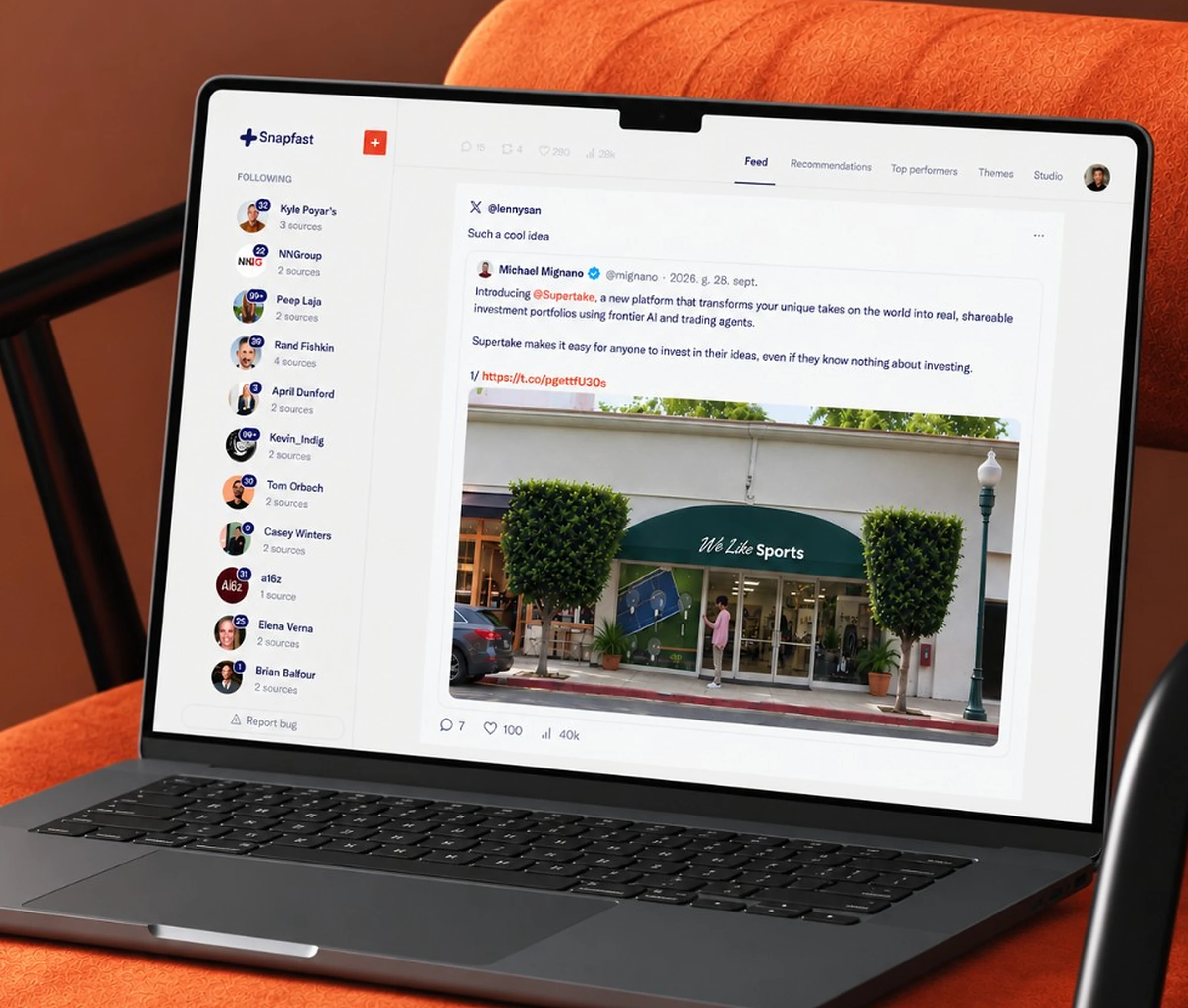
Snapfast tells creators what to post next, based on real posts from the people they follow and on their own channels. People signed up, looked around, and 4 in 100 paid. After the free experience changed, 18 in 100 did.
Free users had no reason to pay. The free version was an archive of real posts, and they still had to do the reading themselves.
I changed what a free user gets in the first session. Instead of a feed to browse, they get a decision: four cards, each with the post to make today, why it should work, and the real posts behind it. Landing, trial, and sign-in were tuned from real sessions at the same time. Free-to-paid conversion went from 4% to 18%, a 4.5× lift.
- 4% → 18%
- free-to-paid conversion, a 4.5× lift
- 4
- cards on screen each day, each one tied to real posts
- 0
- posts published without the creator
Why only 4 in 100 paid
Free users could get most of the value without paying. The free version was an evidence archive: real posts, timestamps, links, engagement. No synthesis.
That solved trust. It did not solve the morning. A library you can scroll is still a library you have to read, so a creator who browsed it for free still had to decide what to post.
What people would pay for
People pay to know what to post today. The early pitch was saved time, an end to jumping between X, YouTube, and Instagram, and they did not pay for it.
The pain that holds is the blank page: what to say today, grounded in what already worked for the people they study and for their own audience.
It is also a daily job. The first version of Snapfast was a different product: compare URLs, prep for a meeting, a few times a month. It reached 286 visitors and $7 over six months. Dan Hockenmaier's line about low-frequency products is that customers forget you, and Hila Qu's answer is to move the product onto a higher-frequency job rather than chase retention tactics. Deciding what to post happens every morning.
Interviews did not surface this. Users who have never had an evidence-backed brief cannot ask for one, so they ask for summaries, alerts, and “what’s trending.” The discovery came from watching the job, then shipping a card they could reject.
What changed for free users
The archive stayed. What a new user sees first changed.
A decision in the first session
Home is the day’s cards, not the feed. Four on screen, two in reserve. A new user sees a post they could make today, for their niche.
Proof on every card
Each card has a brief, a why-line with raw counts, one to three proof posts, and a format on a channel the creator actually uses. A recommendation you can check is one you are willing to pay for.
Your own channel as the baseline
Connect a channel and your own posts become the baseline. The strongest cards are hot in your circle this week and close to something your audience already rewarded.
A draft one click away
“Draft this” opens Studio with the card, the cited posts, and a voice note. From idea to something you can post is one click, so the value lands before the trial ends.
Landing, trial, and sign-in changed from real sessions
Hero, trial, and sign-in changed from what people actually did, not from a persona doc.
Why creators trusted the cards enough to pay
Nobody upgrades a tool they do not trust. A fluent post with an invented fact is worse than a blank page, and one bad card is enough for a creator to stop trusting the rest.
The numbers in the why-line have to be the counts on the cited posts. A tiny baseline is shown as “144 vs usual 2,” not as a dramatic multiple. A card that says a video “said” something must map to a claim extracted from that video. If it does not, the card is dropped.
The model never sees the whole internet. It sees this circle and this account. Claims are extracted only from hook-frame text and spoken words. Empty is allowed. Guessing is not.
Snapfast keeps the person on the card. The model proposes. The creator approves, rejects, drafts, or ignores. In a draft, a personal fact that is not on file becomes a fill-in marker. Publishing stays with the person.
What made fast testing possible
One person ships the whole product as one loop.
I work with Cursor on the codebase and ship ingest, ranking, prompts, and the marketing page the same way: change the rule, watch a real card, tighten the gate that let a bad card through. That pace is what made it possible to keep testing the free experience.
The result: 4% to 18%
Free-to-paid conversion went from 4% to 18%, a 4.5× lift.
The outcome that counts is narrower than a click: the creator posted the card, and it beat their usual engagement. That is the activation metric, the behavior that predicts someone keeps paying.
The loop keeps running. Each generation sees the last 30 days of cards: thumbs and the reason, and what happened after. A rejected angle does not return. A loved quality comes back on a new topic.
What this project teaches
Conversion follows frequency
A tool people need a few times a month gets forgotten before it gets paid for. A daily job gave people a reason to come back, and a reason to pay.
Sell the decision, not the data
Free users can get most of an archive by browsing. A decision they can act on today is the thing worth paying for.
Pick an activation metric that predicts payment
“Posted it, and it beat their usual” is chosen the way Lenny's archive recommends: a behavior that correlates with the outcome, like Snyk's one fix in 30 days. Clicks, thumbs, and opens are inputs.
Trust converts
“556 likes yesterday” can be checked. “This is the winning strategy” cannot. People pay for what they can verify.
Change the trial from sessions, not personas
Ship a version people can reject, then change it from what they do.